Company
Entropy Data joins the Open Semantic Interchange initiative to standardize Semantics
Entropy Data has joined the Open Semantic Interchange (OSI), the vendor-neutral standard for expressing and sharing business semantics consistently across data and AI platforms. We are joining the effort to bring ontology to OSI, and Entropy Data already supports the OSI 0.2.0-draft.

OSI, launched by Snowflake, dbt, and a growing group of more than 60 industry partners, gives organizations a single, portable definition of their business semantics. You define your semantics once and use them everywhere, from a dashboard to a decision agent, and everyone in your stack means the same thing.
A semantic layer for business users and AI agents
Business users and AI agents both need to know what the data means before they can trust an answer. An ontology gives them that: a structured, computable model of business entities, how they relate, and the rules that govern them. The definitions hold their meaning even as tables and pipelines change underneath. This is the part of OSI that the Ontology Representation Working Group is building, and it is where Entropy Data is contributing.
Data only provides value when users and agents understand what it actually means and trust it. With AI, this becomes even more important, both to reason about data and to find related information.
Here is an excerpt of an ontology in the OSI 0.2.0-draft format, as Entropy Data writes it:
version: 0.2.0.dev0
name: main
description: Core business semantics for the demo retail organization.
ontology:
  - concept:
      name: Customer
      type: EntityType
      group: Customers
      description: A natural person who places orders in the online shop.
      iri: http://example.com/b2c/customer
      custom_properties:
        owl:equivalentClass: http://schema.org/Person
    relationships:
      - name: places
        roles:
          - concept: order
            role_name: order
        multiplicity: OneToMany
        verbalizes:
          - "{Customer} places {Order}"
      - name: customer_id
        roles:
          - concept: Customer ID
        verbalizes:
          - "{Customer} has a {Customer ID}"
  - concept:
      name: Customer ID
      type: ValueType
      description: The internal identifier of a customer in the online shop. Guest customers have a Customer ID as well.
      iri: http://example.com/b2c/customer_id
      extends:
        - String
Entropy Data brings a user-friendly editor
High-quality metadata is at the core of Entropy Data. Our Semantics capability lets teams model their business domain as concepts and relationships, link those concepts to the data products that implement them, and query them in natural language. Aligning this model with OSI makes the semantics you define in Entropy Data portable across every OSI-compatible tool.
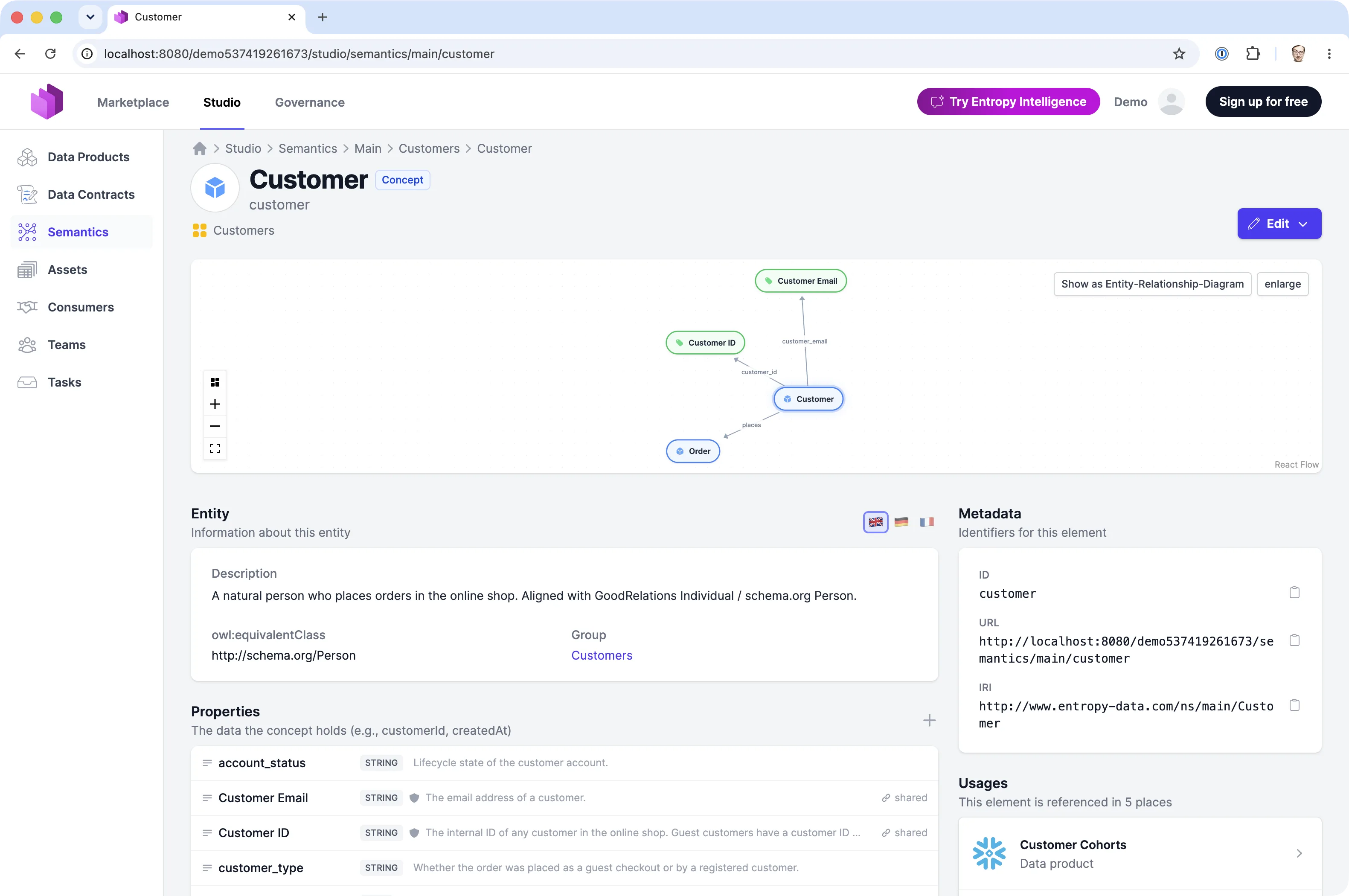
- ✏️ A user-friendly editor for Semantics. Build and maintain your ontology in a visual editor, with the entity-relationship graph, properties, and translations in one place, or edit it directly as YAML.
- 🧩 Concepts and relationships. Model your business domain as a real ontology rather than a flat list of metrics.
- 🔗 Grounded in data products. Every concept links to the governed data products and data contracts that implement it.
- 🤖 Ready for agents. Agents reason over the ontology to answer multi-hop business questions with trustworthy context.
- 🔁 Portable by standard. Export to and import from the OSI 0.2.0-draft, so your semantics stay out of any single vendor's lock-in.
Semantics for Data Products
An ontology on its own is a conceptual model. It says what a Customer is and how it relates to an Order, but it does not point to the table, column, or data product where customer data actually lives. For a business user reading a report, or an AI agent writing a query, that gap is where wrong answers come from: the right term, mapped to the wrong field, or to data nobody can vouch for.
Data Contracts close the gap. They link the conceptual semantic model to the physical model and add a guarantee on data quality. In Entropy Data, a field in a data contract carries an authoritativeDefinitions entry of type semantics that points back to the concept in the ontology. The contract then describes the physical column, its type, keys, and quality rules, while the link tells you which business concept it implements.
apiVersion: "v3.1.0"
kind: "DataContract"
id: "customers_latest_pii_v1"
name: "Customers Latest"
schema:
  - name: "customers"
    physicalType: "table"
    businessName: "Customers"
    description: "Retrieves and transforms customer data from the CRM source system. One row per customer, deduplicated on customer_id. Includes demographics, contact info, segmentation, and account lifecycle timestamps."
    properties:
      - name: "customer_id"
        logicalType: "string"
        required: true
        unique: true
        primaryKey: true
        tags:
          - "business-key"
        authoritativeDefinitions:
          - type: "semantics"
            url: "http://example.com/b2c/customer/customer_id"
With that link in place, the meaning of customer_id and the guarantee that it is a required, unique business key live in the same place. Business users see a trusted term backed by a contract and an owner. AI agents resolve a concept to the exact field they are allowed to query, with the quality rules attached. The same link travels through OSI, so other tools read the same definitions.
Support for the OSI 0.2.0-draft available today
Entropy Data is a member of the OSI Ontology Representation Working Group and supports the OSI 0.2.0-draft in its platform today. As the specification advances toward a stable release, Entropy Data will support each draft and contribute its experience modeling business semantics on top of governed data products and data contracts.
Entropy Data invites data and analytics teams to explore how an ontology grounded in data contracts improves metadata quality for business users and AI agents alike.
About Entropy Data
Entropy Data provides a platform for governed data products, data contracts, and business semantics, with high-quality metadata at its core. Teams model their business domain as an ontology of concepts and relationships, ground it in the data products and contracts that implement it, and make it queryable for both business users and AI agents. Founded in 2025 as a spin-off from INNOQ and based in Germany, the company was co-founded by Dr. Simon Harrer (CEO) and Jochen Christ (CTO). Learn more at entropy-data.com.
About the Open Semantic Interchange (OSI)
The Open Semantic Interchange is a vendor-neutral standard for expressing and sharing business semantics consistently across data and AI platforms. Launched by Snowflake, dbt, and more than 60 industry partners, OSI lets organizations define their semantics once and use them across any compatible tool. More information at open-semantic-interchange.org.
Media Contact
Dr. Simon Harrer, Co-founder and CEO
Entropy Data
hello@entropy-data.com